
 05 December 2025
The biotech website is the single point where investors verify your science, partners evaluate your capabilities and recruits assess your team. The goal is to make this high-stakes evaluation process transparent and straightforward.
You have multiple options for development: specialised agencies or assembled freelance teams, template platforms or custom development. Each carries distinct implications for cost, timeline, and maintenance. The right choice depends entirely on your current stage, budget, technical requirements and internal resources.
This guide walks through the practical decisions involved from structuring your project team and choosing the right platform to organising high-value content and maintaining momentum post-launch. The goal is to help you build a functional resource that serves your business objectives without overspending or overcomplicating the process.
Part 1. Assembling your biotech website project team
You have two primary options: work with a specialised agency or curate your own team of freelancers and contractors.
Option 1. Specialised agency
Working with an agency experienced in biotech or life sciences often saves significant time and budget. They understand the regulatory environment, know how to present scientific data credibly and do not need to learn industry terminology on your dime.
Why experience matters? A generic web agency will struggle with decisions like how to structure a pipeline page or communicate a complex mechanism of action. You'll end up paying for their learning curve through lengthy revision cycles.
A proven agency typically provides better ROI for biotech companies because they staff efficiently from day one and can flex specialised resources as needed.
Best for: Companies seeking a fast launch and aiming to focus internal resources exclusively on science.
Option 2. Building your own team
If you choose to assemble a custom team, you'll need to find freelance or part/full-time specialists:
- Graphic Designer: handles visual assets and branding (if not already established)
- UI/UX Designer: structures the user experience and designs interfaces for maximum clarity
- Business Analyst (optional): maps user flows and information architecture; manageable internally if your team deeply understands audience needs
- Front-end Developer: builds the actual website interface.
- Back-end Developer (conditional): necessary only for custom functionality beyond a standard CMS
- Copywriter: writes clear, appropriate content for different audience levels
- QA: tests functionality meticulously across all devices and browsers
- DevOps Engineer (conditional): handles deployment and infrastructure; often bundled with agency packages
- Project Manager (optional): coordinates the team; you can manage this yourself for smaller projects
Best for: companies with strong internal project management capacity and tight budget constraints.
Part 2. Technical foundation decisions
Platform Selection
| Platform | Description | Cost (approx.) | Timeline (approx.) |
|---|---|---|---|
| Custom development | Complex data visualisation, protected data rooms, unique internal integrations. | $5,000+ | 3+ months |
| Template-based platforms | Webflow: design flexibility without heavy coding; robust built-in CMS. Popular with early-stage biotech. WordPress: wide availability of plugins and themes. Requires significant customisation to meet modern design standards. | $2,000+ | 1+ month |
Recommendation: Most early-stage biotech companies launch efficiently using Webflow or WordPress. Custom development is generally justified only at Series B+ or when truly unique technical requirements exist.
CMS Requirements
A CMS (Content Management System) lets non-technical team members update content without developer assistance. You need a CMS if:
- Non-technical personnel will regularly update news, publications or blog content
- You anticipate frequent updates to pipeline status or data sets
- You plan on publishing ongoing research updates
Domain and hosting
Domain selection:
- Secure your exact company name .com immediately.
- Register common misspellings or relevant TLDs (e.g., .bio) as redirects to protect against brand exploitation.
| Status | Example TLD | Reason |
|---|---|---|
| Primary (must-have) | .com | Global standard, highest trust level. |
| Secondary (redirects) | .bio, .co | Industry relevance; good for protecting brand integrity. |
| Avoid for primary use | .net, .org, .info, .xyz | Signals an inability to secure the main domain, which can subtly damage credibility. |
Hosting:
- For template platforms: hosting is typically included in platform fees ($20–$80/month)
- For custom sites: utilise AWS, Google Cloud or specialised hosts ($100–$200+/month depending on traffic)
- Budget for an SSL certificate (often free) and reliable backup services
Part 3. Core site structure
Your website needs two page types: essential pages required for verification, and optional pages that deliver value only when you have meaningful content to fill them.
Essential pages
Every biotech company, regardless of stage, must present a unified set of core pages that serve as milestones for investors and partners. These pages must be fully populated and easy to navigate. Failure to include or properly populate any of these elements will immediately signal immaturity to evaluators.
| Page | Purpose | Description and key requirements |
|---|---|---|
| Homepage | Establish scientific credibility in 10 seconds | The three-sentence scientific abstract must be the hero content |
| Pipeline | Risk assessment tool for investors | Structure this as a data table, not an infographic. Include current development phase, target indication and clear projected milestones |
| Platform/Technology | Explain your core scientific approach | Feature mechanism of action diagrams, assay workflows and validation data with direct links to publications |
| Data & Publications | Provide verifiable evidence | List peer-reviewed papers, preprints, conference presentations and patent filings. This must be easily accessible |
| Team | Demonstrate expertise | Highlight scientific founders, C-suite and especially your Scientific Advisory Board with institutional affiliations clearly stated |
| News/Press | Signal operational momentum | Update quarterly minimum with milestone achievements or significant hires |
| Contact | Enable outreach | Keep it simple: email form, business development email and a physical address for credibility |
Tip: post real pictures and links to LinkedIn accounts. This proves transparency and validates the human capital behind the idea.
Optional but valuable pages
While the essential pages are non-negotiable, these secondary pages can significantly boost your credibility and signal growth, but only if they are properly maintained. You should only include them if you can fill them with meaningful, current content.
| Page | When to Include | Risk, if page is poorly executed |
|---|---|---|
| Partnerships | If you have meaningful, recognised collaborations with institutions or pharma | Absence of known partners makes the page appear empty; better to omit it entirely |
| Investors | List only if you have Tier-1 institutional investors (VC/PE) | Structure this as a data table, not an infographic. Include current development phase, target indication and clear projected milestones |
| Blog/Insights | If you can commit to regular updates | Irregular updates (e.g., once every six months) create an impression of company inactivity |
| Careers | Only if you are actively hiring | Half-filled or outdated job boards instantly signal internal disorganisation |
Part 4. Information architecture
Before any design work begins, map the exact user flows for your three primary audiences:
- Investors: Homepage → Pipeline → Data/Publications → Team
- Pharma/Partners: Homepage → Platform/Technology → Data → Contact
- Scientific Recruits: Homepage → Team → Publications → Platform
Practical Step: document the top three questions each audience has. Ensure those answers are accessible within three clicks from the homepage.
If you are unsure of user needs, hire an experienced analyst to map these flows. Poor information architecture is the most common failure point – users abandon the site if they cannot find what they need immediately.
Part 5. Content development
Scientific narrative
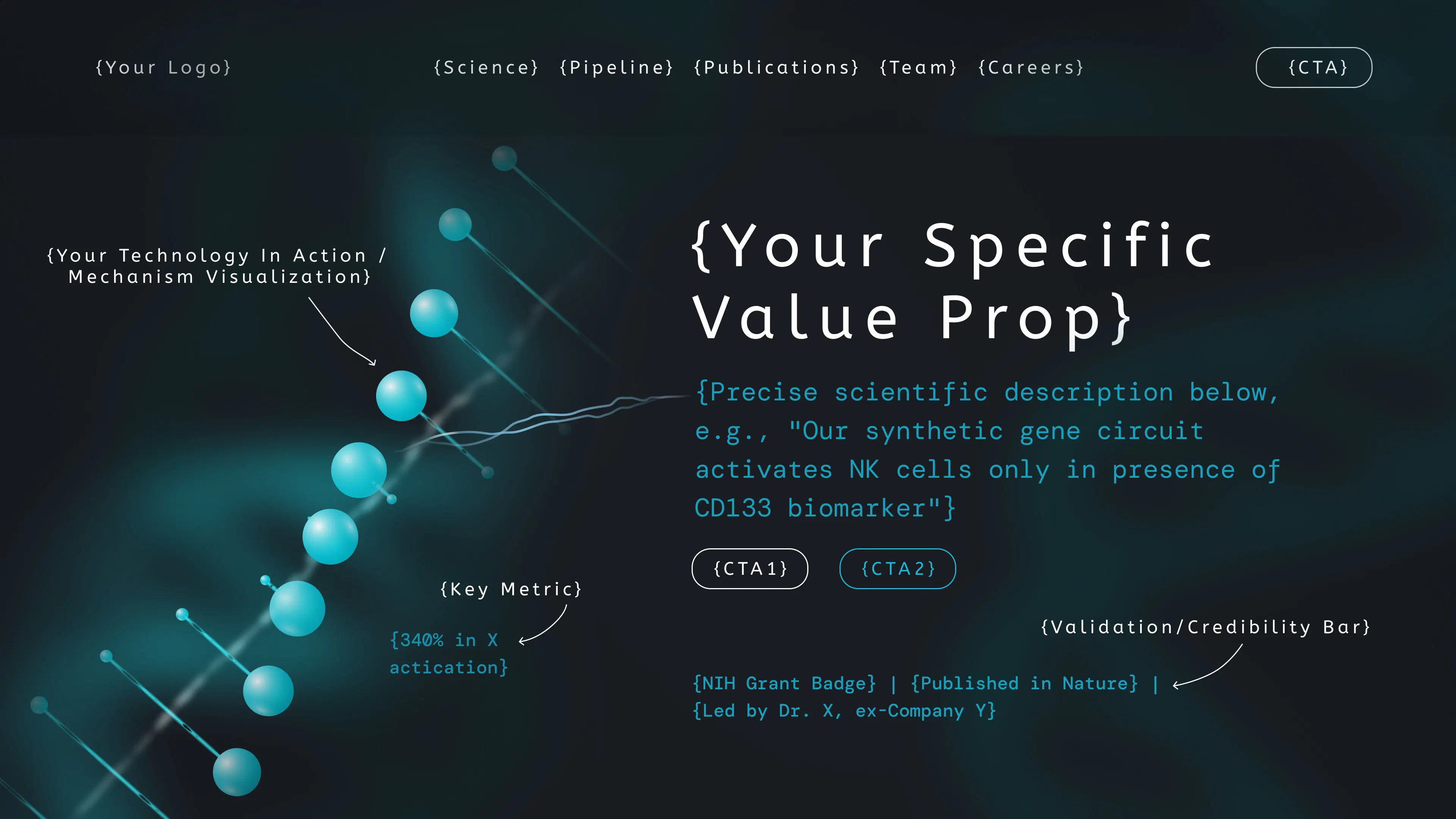
Start with a three-sentence abstract that defines your scientific identity: mechanism, target and potential impact. This forms your homepage headline and governs all subsequent messaging. Example structure:
- "[Company] develops oral small molecule inhibitors targeting Kinase-Z, a validated driver of [disease]"
- "Our platform enables selective binding that overcomes resistance mechanisms observed in first-generation inhibitors"
- "Lead candidate TS-102 has demonstrated [specific efficacy metric] in preclinical models"
Terminology Consistency
Create a master terminology document. If you designate a target as "Kinase-Z" on one page, avoid calling it "Kinase Z pathway" or "the target kinase" elsewhere. Inconsistency signals sloppiness and raises concerns about scientific rigor.
Visual content
Commission functional diagrams, not decorative graphics:
- Mechanism of action schematics
- Assay workflow diagrams
- Chemical structure comparisons
- Efficacy charts derived from published data
Design these visuals to be clear and printable in black and white, as they will inevitably be used in due diligence folders.
Part 6. Pre-launch preparation
The development phase concludes with a critical audit. These steps ensure your website is not only scientifically accurate but also technically robust, legally compliant and easily discoverable by the specialised audiences who conduct due diligence. This final phase focuses on operational excellence before the public launch.
SEO Fundamentals
- Descriptive page titles (e.g., "Kinase-Z Inhibitor Pipeline | [Company Name]")
- Meta descriptions for every page (150-160 characters explaining page content)
- Alt text for all images and diagrams
- Clean URL Structure (/pipeline, /platform, not /page-id-4729)
- Mobile responsiveness (non-negotiable)
- Fast load times (compress images, use modern formats)
- Register your website and submit your sitemap in Google Search and Bing Webmaster
- Connect your website to SEO online tools to check your domain rating and SEO score
Note: if you use an agency, this must be included in the development package. Don't overthink SEO for biotech. Your audiences find you through direct channels (investor networks, conferences, publications), not Google searches. Focus on clarity over keyword optimisation.
The five-click test
Before launch, have someone unfamiliar with your company attempt to locate the following critical data points:
- Your lead candidate's current development phase
- A specific SAB member's institutional affiliation
- Your most recent peer-reviewed publication
- The projected milestone date for your platform's next validation study
If any of these items require more than five clicks from the homepage, the navigation is fundamentally flawed. Complex navigation raises red flags for time-constrained investors and forces them to manually search for data, slowing down the evaluation process. Simplify the navigation immediately if the test fails.
Legal and compliance
Compliance represents a foundational requirement for operating in the biotech sector. Ensure the following items are implemented and easily accessible, as they demonstrate professional governance:
- Forward-looking statements disclaimer (especially for pipeline projections)
- Privacy policy (required if collecting any user data)
- Cookie consent
- Accessibility (WCAG 2.1 AA standards protect you legally and expand your audience)
Part 7. Post-launch operations
The site launch marks the start of an ongoing commitment. A static website quickly loses credibility; therefore, post-launch operations must prioritise active maintenance and consistent content updates. This ensures the site continues to accurately reflect the company's progress and operational health.
Content maintenance schedule
Stale content is a critical liability. If your last news update is 18 months old, investors immediately conclude the company is dormant or struggling for momentum.
| Content area | Maintenance requirement | Strategic rationale |
|---|---|---|
| News section | Update quarterly minimum | Signals sustained operational activity, not stagnation. |
| Pipeline status | Update within 2 weeks of any milestone achievement | Confirms accountability to the milestones published for investors and partners. |
| Publications | Add immediately upon journal acceptance or conference presentation | Maximises the impact of third-party scientific validation. |
| Team updates | Update within 1 month of significant hires or advisory board additions | Reinforces human capital strength, which is a key de-risking factor. |
Ongoing support options
The complexity of biotech websites necessitates planned post-launch technical and content support. Do not let technical debt accumulate.
| Support model | Description | Best fit |
|---|---|---|
| Retainer with agency | Dedicated monthly hours for bug fixes, security patches and minor content adjustments. | Companies needing predictable technical stability and external QA coverage. |
| As-needed developer | Engaging a freelancer or contractor strictly for occasional fixes and ad-hoc feature additions. | Startups with very low update frequency and a tightly controlled budget. |
| In-house content manager | Hiring a part-time or dedicated internal resource (often combined with another role). | Companies generating heavy, consistent content (blogs, data updates) who need rapid turnaround. |
Plan to allocate approximately 10–15% of the initial build cost annually for hosting, licenses, maintenance and essential content updates. Viewing this as an operational expenditure (OpEx), not a one-time capital expense (CapEx), is crucial for long-term credibility.
Analytics
Install Google Analytics or similar from day one. Analytics are not vanity tools; they provide actionable insights into evaluator intent and information friction.
Track these critical metrics:
- Which pages users spend the most time on: this reveals what aspects of your platform or science are generating the deepest engagement. If time on your Mechanism of Action page is high, it validates that your scientific narrative is compelling.
- Where users drop off (exit rate): high exit rates on key pages (e.g., the Pipeline or Team page) signal a potential issue with content credibility or structure. A high drop-off on the Pipeline suggests investors are not finding the required risk/timeline data.
- Traffic sources: tracking sources reveals which external activities are successfully driving expert traffic. If traffic spikes after an event or publication, it quantifies the ROI of that specific external validation effort (conference, journal, partnership announcement).
Review these metrics quarterly. Use the data to strategically adjust your site's navigation, prioritise content (e.g., move high-engagement data points higher on the homepage) and streamline the path for future due diligence.
Conclusion
Ultimately, the creation of an effective biotech website hinges on strategic governance: disciplined decisions regarding the development team structure, the choice of technical platform, rigorous content organisation and a critical commitment to continuous maintenance. The strategic approach for a pre-seed company with limited resources naturally differs from the complex data requirements of a Series B company.
The guiding principle must be precision over mere polish. Your highly specialised audiences (spanning investors, potential partners, and scientific talent) require immediate validation via verifiable data: the current status of your pipeline, published research, team expertise and the core scientific methodology. Ensure these critical data points are readily discoverable and rigorously maintained.
The specific platform, initial design expenditure and budget allocation are secondary factors compared to the imperative of consistent operational execution. A well-maintained site built on a template, but robustly maintained with quarterly scientific updates, will invariably achieve your business objectives more effectively than an expensive custom build that remains stagnant for eighteen months.
From December 1 to 31, CodePhusion is offering a free biotech website audit. This includes technical review, accessibility, messaging, site structure and actionable improvement recommendations. Spaces are limited, so submit your application through the form below.
Request your free biotech website audit
Get free expert analysis of your biotech website's technical performance, accessibility, messaging and structure.
15 spots available for December - secure yours now.