


AI agents now search sequence databases, design proteins, process raw instrument files and run automated experiments, with people setting the goal and doing the bench work. This guide sorts that work by type and covers what your lab data needs first.
This guide is for lab directors, R&D leads and biotech founders deciding what AI agents in life sciences mean for their lab. In 2026 Anthropic launched Claude Science as a standalone research product and opened its own wet lab, and OpenAI released Rosalind Workbench and bought Orchestra Bio, a startup whose agents coordinate drug development operations.
The published results are strong and easy to misread. An agent pointed at a task it cannot do yet, or at records it cannot read, uses up the pilot budget, and in a regulated lab agent output that reaches a GxP record (one kept under good practice rules such as GLP or GMP) without review is something an auditor will flag.
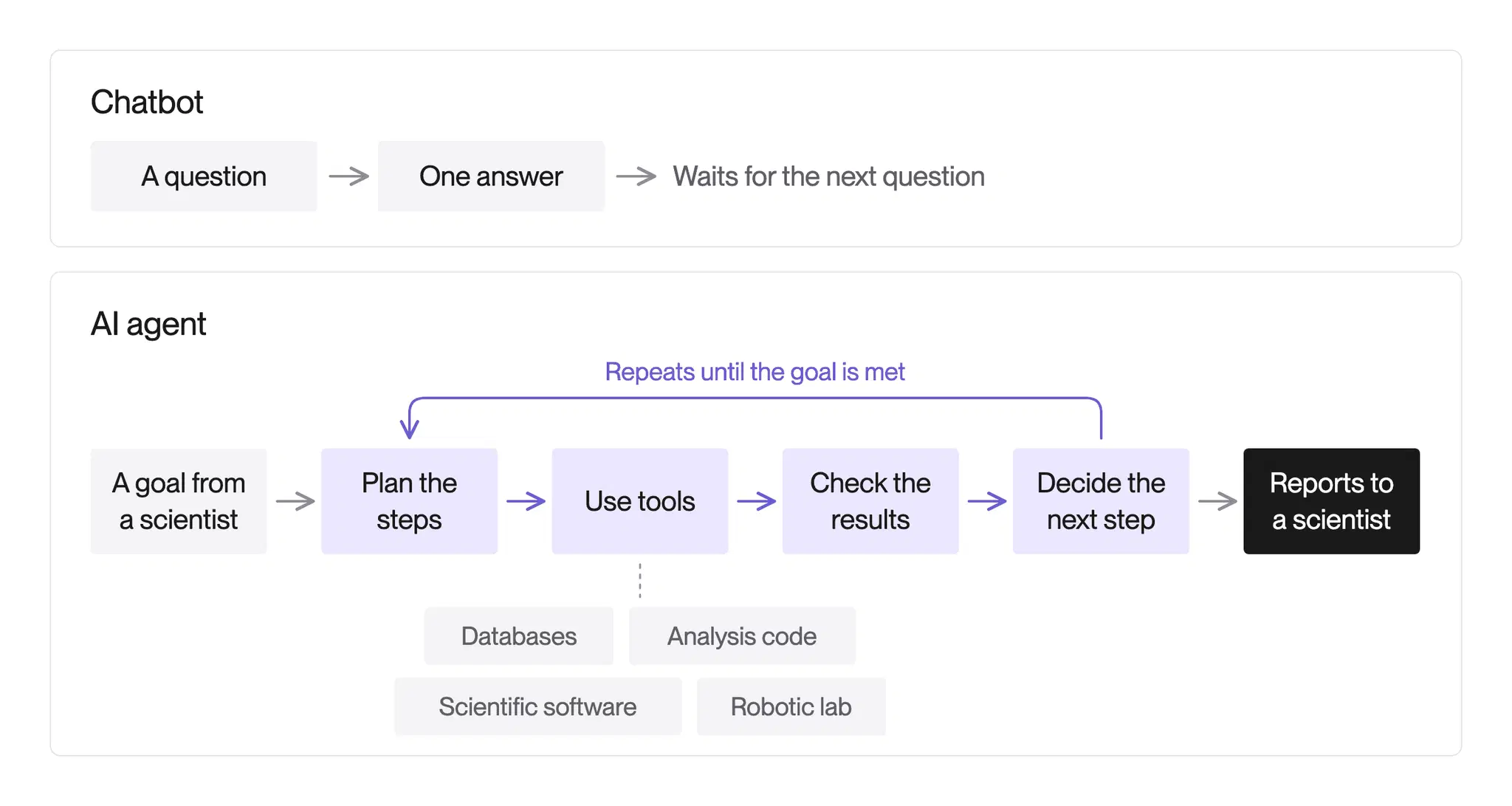
A chatbot answers the question it is given and then waits. An AI agent works toward a goal in a loop: it plans the steps, carries them out with tools, checks the results and decides what to do next, until the goal is met or a person has to decide. In a lab the tools are databases, code the agent writes and runs, scientific software and, in an automated lab, the robots.
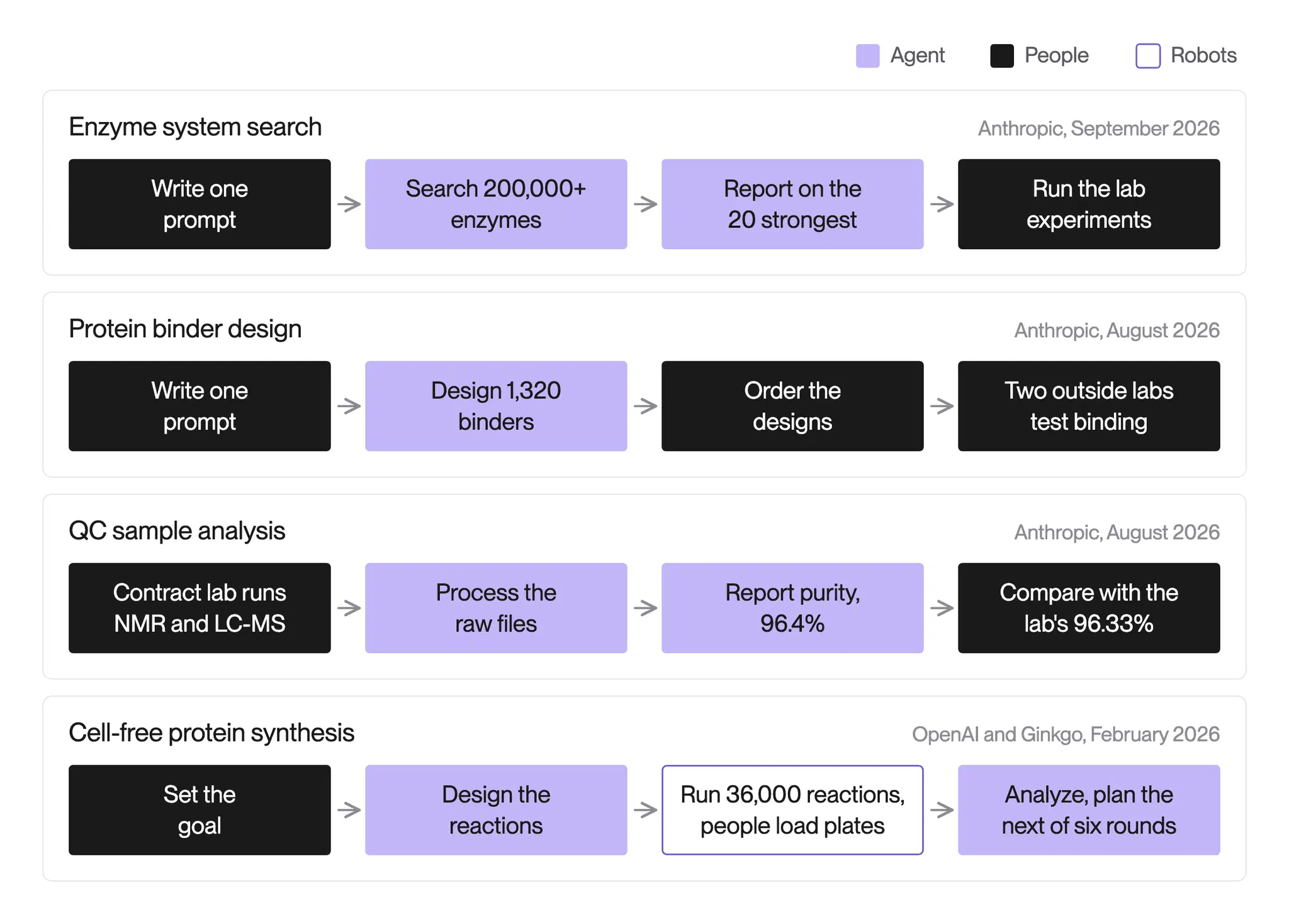
In September 2026 Anthropic reported that Claude had found a previously unknown enzyme system with features that resemble CRISPR. From one prompt, about 950 agents searched a DNA sequence database for 21 hours and wrote reports on 20 of the 3,500 candidate systems they found, while people wrote the prompt and did the lab work.
Agents do their best work where the data is large, structured and easy to check, and they need more help as the work gets physical. The results published so far fall into seven kinds of work.
Agents can search public sequence, structure and literature databases at a scale no lab team can match, but the results still need checking. In a June 2026 Anthropic study, agents asked to pull viral sequences from NCBI missed records in large result sets, applied filters wrongly and gave different answers to the same question, until the researchers added a fixed retrieval tool that raised accuracy above 90 percent. Claude's life sciences connectors reach PubMed, bioRxiv, Open Targets, ChEMBL and ClinicalTrials.gov.
In August 2026 Anthropic published a protein design campaign in which Claude designed binding proteins against 15 targets with no scientific guidance after the first prompt. Two outside labs confirmed 354 binders out of 1,320 designs, covering 14 of the 15 targets, at a hit rate of 22.6 to 35.1 percent depending on the model and setup, against the 10 to 15 percent Anthropic gives as normal. The agent proposed candidates and lab tests decided which ones worked.
Anthropic gave Claude the raw NMR and LC-MS files a contract lab produced for a routine quality control sample, and Claude processed both in under 25 minutes, close to the 30 to 60 minutes a chemist spends on a sample by hand. Its purity figure of 96.4 percent matched the lab's 96.33 percent, and the lab's finished report arrived four days after the first spectrum, so the gain is in turnaround and in the analyst's time. It worked out an undocumented vendor file format on its own, and it was one sample from one lab, a long way from a validated method.
Claude Science and Rosalind Workbench are both built around this. The agent writes the analysis, runs it on the lab's own cluster or rented GPUs and keeps the code with every figure, so a scientist can trace each result back to how it was made, and Rosalind Workbench has the scientist approve the analysis plan before it runs. An Anthropic research model also sped up more than 30 open-source biology models about four times on average with a small loss of precision.
Closed-loop experimentation, where the agent designs an experiment, a robot runs it and the agent plans the next round from the results, is as far as agents have gone into physical work. In February 2026 OpenAI and Ginkgo Bioworks connected GPT-5 to Ginkgo's cloud lab, and across more than 36,000 reactions it cut the cost of producing a benchmark protein by 40 percent against the previous best result, while people prepared reagents and loaded plates. It covers one protein, in a lab where robots record every step.
Document drafting gives a saving you can measure because the review step already exists. Novo Nordisk says Claude cut its clinical study report writing time by 90 percent, with drafts going to people for review and approval, and Rosalind Workbench covers evidence review.
OpenAI's October 2026 purchase of Orchestra Bio points agents at drug development operations. When a manufacturing batch fails and threatens a trial start, Orchestra's agents identify which milestones have to move and lay out the options for the program team. This work runs on LIMS records, batch status and schedules, and its value is easier to measure than discovery work, because a delayed trial start has a cost a company can count this year.
AI agents in life sciences by type of work
| Type of work | Published example | Evidence | The lab supplies |
|---|---|---|---|
| Searching datasets | Enzyme system found in public DNA data | Lab tests, preprint | Database access, a reviewer |
| Designing proteins | Binders for 14 of 15 targets | Two outside labs | Targets, lab testing |
| Processing instrument data | NMR and LC-MS in under 25 minutes | One lab report | Readable raw files |
| Writing analysis code | 30+ biology models about 4x faster | Outputs compared | Datasets, compute |
| Automated experiments | 40% lower protein production cost (Ginkgo) | Preprint, one protein | A robotic lab |
| Drafting documents | CSR writing time down 90% (Novo Nordisk) | Vendor customer story | Templates, source data |
| Drug development operations | Orchestra Bio, bought by OpenAI | None published yet | Schedules, budgets, batch status |
As published by the companies and their partners, February to October 2026.
People took part in every result above. In Ginkgo's lab robots ran the reactions while people prepared the reagents and oversaw the work, and Anthropic says of its own lab that "all of the lab work is performed by human scientists". The largest claims are also still waiting for outside confirmation.
Discovery claims need the same checking as any preprint. Anthropic's CEO said the enzyme system was found "mostly, though not entirely, by Claude" and that a Stanford team had earlier found a system with similar features. Feng Zhang, one of the scientists behind CRISPR genome editing, reviewed the preprint.
This is an exciting example of how AI agents can contribute to biological discovery.
He also said it merits further investigation.
The hit rates and speedups in this article come from the companies selling the agents, so treat them as a reason to run your own test, which our guide on how to evaluate an AI tool for your lab covers. For what each company sells, see AI models for life sciences in 2026. Access is gated too, since GPT-Rosalind and Anthropic's Life Sciences Verification Program both put the strongest biology features behind an approval step.
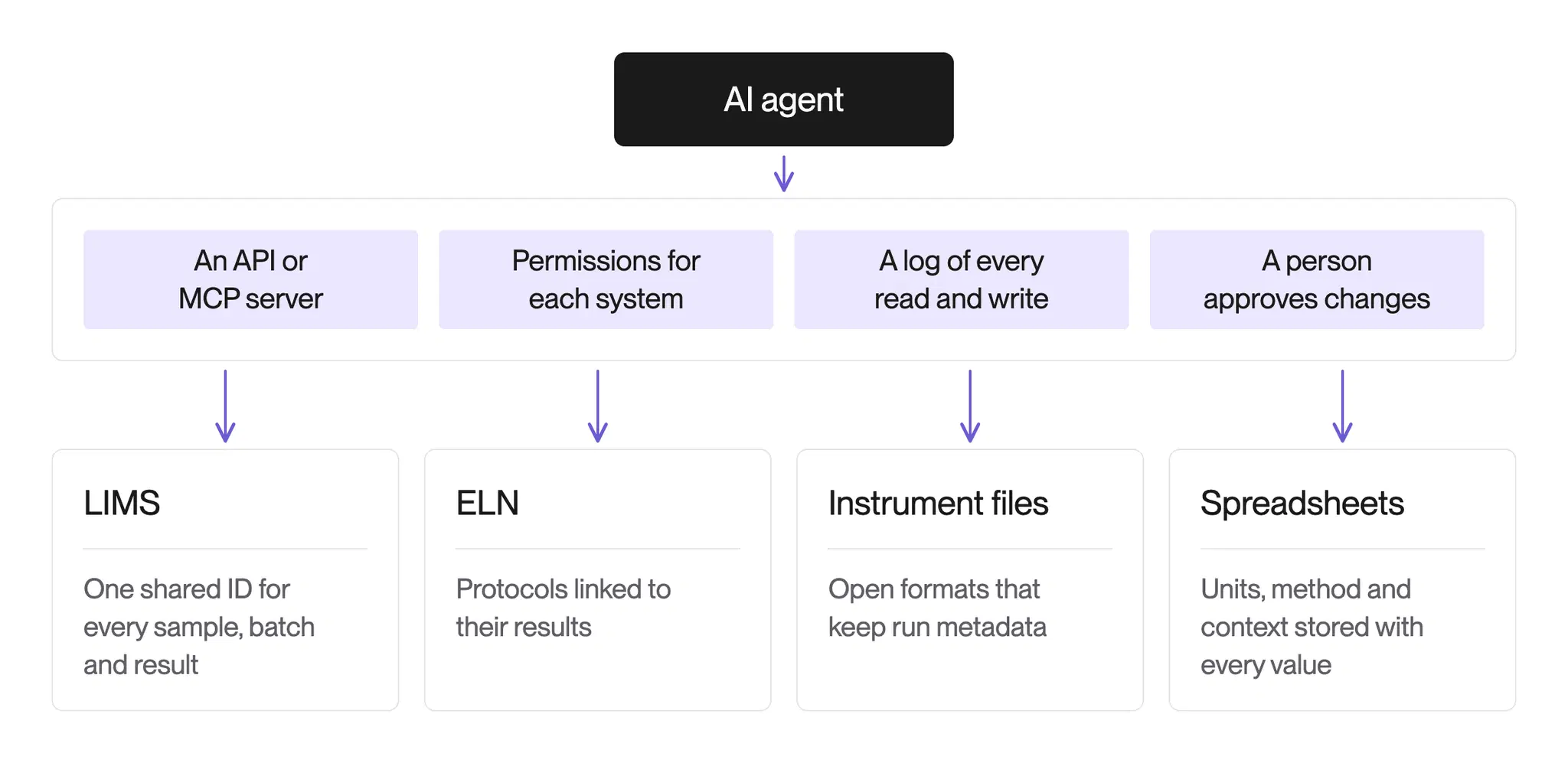
The results that worked best ran on machine-readable data. A working lab spreads that data across a LIMS, an ELN, instrument PCs and spreadsheets set up for people, so an agent needs the following first.
- One identifier for every sample, batch and result across systems, so the agent can connect a LIMS result to its run file and its ELN protocol.
- Units, method and context stored with each value, since a cell that says 12.4 means nothing to an agent without mg/mL, the plate and the run date.
- Instrument output in a format the agent can parse. An open standard such as Allotrope is easier to check than a decoded vendor format.
- A way in. Benchling has a connector for Claude, while a custom or older LIMS needs a controlled interface such as an API, a connector or file exports, with an MCP server (Model Context Protocol, the open standard agents use to connect to software) as one option. See which lab integrations save time.
- A log of every read and write the agent makes, in the same audit trail your staff already work under.
Want an AI agent to work with your lab data?
We build the LIMS integrations, APIs and data cleanup that let AI agents read your lab records, with an audit trail for every read and write.
Book a discovery callWhere to start with AI agents in your lab
Pick one type of work from the table where your data is clean and a person already reviews the output, such as literature review or analysis of a dataset you already export. Run a four- to six-week pilot, count the hours saved and the errors your reviewers catch, and keep a person approving anything that leaves the pilot.
Then list what the agent could not reach: records without IDs, values without units, instrument files only the vendor software can open and systems with no API. That list decides how far agents can go in your lab. If you want help connecting an agent to your LIMS or ELN, book a discovery call with our team.