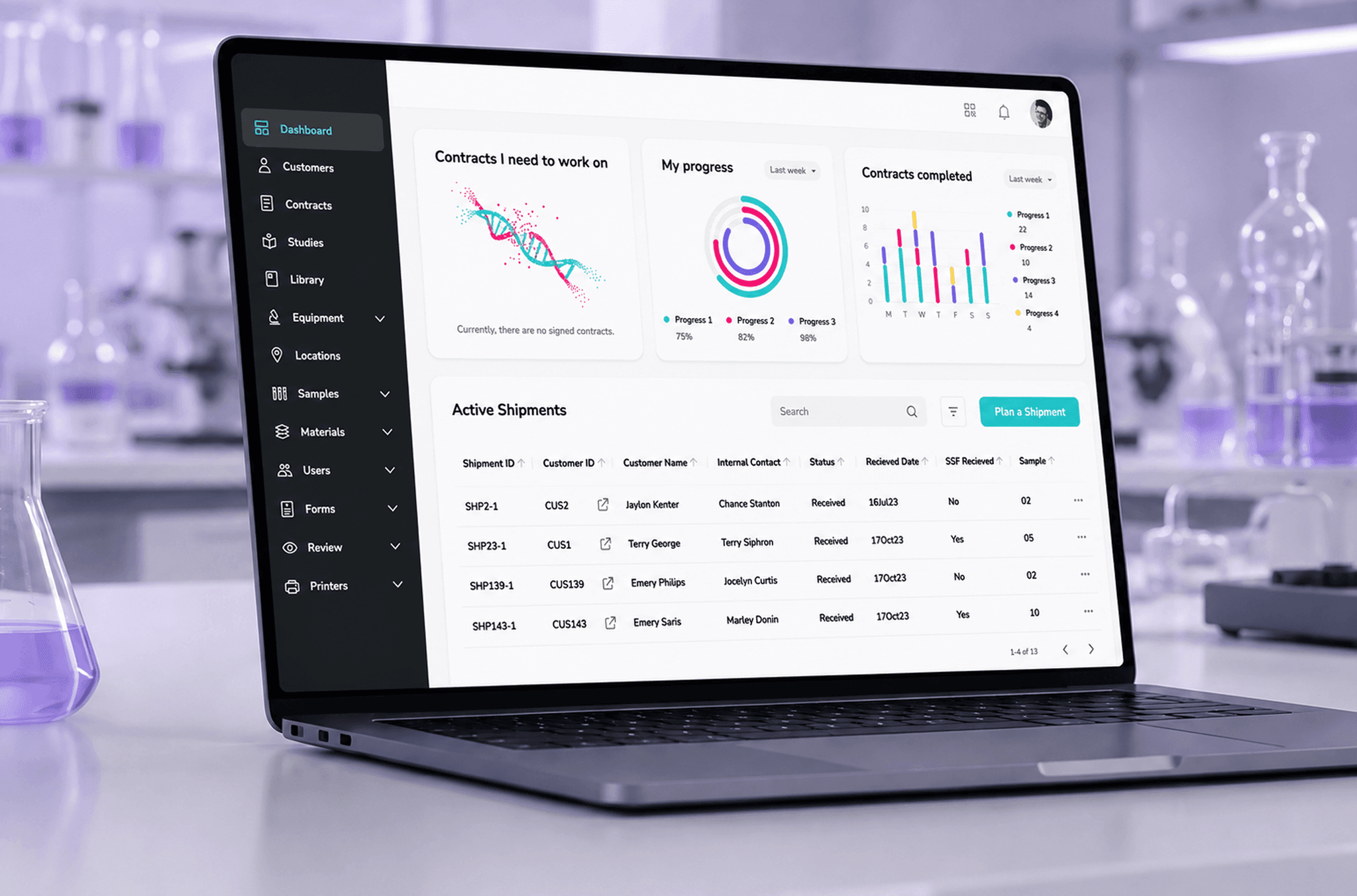
A LIMS for a CRO is the system of record for laboratory work performed on behalf of other companies. It tracks samples, studies, results, and documents like any laboratory information management system, and it also has to know which sponsor owns each record, who is allowed to see it, and what was contracted before the work started.
A single-lab biotech asks its LIMS what happened to a sample and whether the result met specification. A CRO asks the same question and then has to answer it per sponsor, per study, per contract, and answer it for people outside the company.
Four things change:
- Ownership becomes an attribute of every record, since each sample, result, document, and report belongs to one sponsor.
- Access control gets audited by people who are not your employees, because sponsors and regulators both ask who could see what and when.
- Work is organized around studies and contracts with a scope, a price, and a deliverable, rather than ongoing internal programs.
- Reporting has to produce a sponsor-facing document, not only an internal query result.
The audience for your audit trail is wider too. Under the ICH E6(R3) good clinical practice guidance the FDA adopted in 2025, a sponsor stays accountable for overseeing the service providers it delegates work to, including data governance across the record lifecycle. So sponsors come asking for evidence, and your system either produces it or your team assembles it by hand.
Two different things get called data separation. One is separating infrastructure, giving each client its own database or instance. The other is separating records inside one system the whole lab works in. A CRO needs the second, because the lab shares instruments, staff, freezers, and inventory, and splitting that per sponsor means no one can see the lab.
The working rule is that a record carries its sponsor and that sponsor is checked on every read, not enforced by which login page someone used. Then a scientist covering four sponsors gets one work queue, a sponsor user sees their own studies and nothing else, and the rule holds whether the request arrives through the interface, a report, or the API.
Shared resources are where designs go wrong. A freezer, a pipette, an HPLC column, and a reagent lot belong to no sponsor, but their calibration and lot history is evidence inside every study that used them, so those records have to appear in one sponsor's audit package without exposing the other studies the same instrument ran. Blinding works the same way, with bench staff unable to identify a test article while the study director keeps the link.
The unit of work at a CRO is the study, and the LIMS should model it directly, with a protocol, a sponsor, a study director, a schedule, the samples in scope, the methods and acceptance criteria, deviations, and the final report.
For non-clinical safety work under 21 CFR Part 58, the quality assurance unit has to maintain a master schedule of all studies indexed by test article, showing the test system, nature of the study, initiation date, current status, sponsor, and study director. That is a screen in a well-built LIMS, and when the system cannot produce it someone maintains it in a spreadsheet by hand, which is the exact record an inspector compares against the system.
The contract side matters just as much and is the part lab software leaves out. The system should know what was quoted, which tests were agreed, at what price, and what changed after signing. Without it, a CRO finds out at invoicing that it ran forty samples it never billed for, or that a sponsor disputes scope with no record of the change order.
Traceability at a CRO starts before the sample is in the building, with the shipment's condition and temperature on arrival, then accessioning that links every tube to the sponsor and the study. From there the system follows aliquots, storage positions, transfers between sites, and eventual disposal or return.
The part product demonstrations skip is the analytical run that mixes sponsors. One plate can carry samples from four clients, and the run record spans all of them while each sample belongs to one. If the data model allows only one sponsor per record, your team either splits runs artificially or stops linking samples to runs, and both cost you the traceability you bought the system for.
Retention lasts long after the work does. Part 58 requires archives with orderly storage, expedient retrieval, a named person responsible, restricted entry, and indexing so material can be found, so when a contract ends you can say what you still hold for that sponsor and where it is.
Inventory splits in two. Consumables, reagents, reference standards, and controls are shared across the lab and tracked by lot, with the link from lot to result preserved. Sponsor-supplied test articles are owned by one client, restricted in use, and reconciled against what was sent and what remains.
Documentation has to be versioned and recoverable by date, because when a sponsor asks which method was in force the day their study ran, the answer is the SOP version effective that day. Sponsor-specific method variants make this harder, so the system has to attach the right variant to the right study.
Reporting has two audiences. Sponsor-facing reports should come from the same records the lab audits internally, because a report assembled separately in a document editor creates a second set of numbers that can disagree with the system. Internally you need the view no sponsor sees: capacity by department, turnaround time by client, how heavily each instrument is booked, and which studies are late.
Decide which of these has to work at go-live and which can wait, because integration scope drives the timeline more than feature count does:
- Instruments and their data systems, including plate readers, chromatography data systems, balances, and liquid handlers, through vendor drivers or parsed result files.
- An ELN, where the experimental narrative lives and the LIMS holds the structured records, covered in our guide to choosing between lab software options.
- Finance and invoicing, so a completed study turns into an invoice against what was contracted.
- Sponsor delivery, whether that is a portal login, a scheduled export, or an API the sponsor's systems pull from.
- Identity and single sign-on, including how external sponsor accounts are created, reviewed, and removed when a contract ends.
It can, and for a lab selling a defined catalog of analytical tests run to standard methods it should. Several commercial vendors sell CRO and CDMO configurations with sponsor fields, per-client permissions, study templates, and report generation, and that is the faster and cheaper path.
Where each option breaks down:
Where each option breaks down
| Option | Best for | Where it breaks down |
|---|---|---|
| Commercial LIMS with a CRO configuration | A standard service catalog and sponsors who accept a report by email or portal download | Study lifecycles that do not match the product's model, and sponsor access the vendor does not offer |
| Configurable platform | A service mix still changing, where you need new assay types without a vendor ticket | Multi-sponsor permissions and contract workflows beyond what configuration reaches |
| Custom build | Labs where the platform is part of what sponsors buy, or that have outgrown a commercial system | Cost and time to first release, and validation evidence you produce yourself |
Our guide on when to build a custom LIMS instead of buying one works through that comparison in detail. Whichever route you take, responsibility for the system's suitability stays with your lab, and where your records fall under 21 CFR Part 11 you own the validation and the audit trail evidence regardless of who wrote the software.
RoukenBio is a contract research organization in the UK with more than 100 employees. They were running on a mix of outdated lab systems and manual processes that scattered data across disconnected tools and made version control and traceability hard to hold. We built them a custom LIMS that pulled twelve-plus operational areas into one platform, covering versioned documentation, sample and shipment tracking, equipment scheduling, study lifecycle management, inventory, and audit trails with role-based access.
The modules that mattered were the CRO-specific ones. Study lifecycle management, shipment tracking, and role-based audit history are where a general-purpose LIMS asks a contract lab to work the way the product expects. The build ran three years from proof of concept to full rollout and now supports more than 100 users, with a usable core in production early and modules added while people were already working in the system. The full RoukenBio case study has the detail.
Choosing a LIMS for your CRO?
We build multi-client LIMS for contract research labs, and we will say when configuring a product is the better call.
Discuss your study workflowsHow to evaluate a LIMS for your CRO
Write down your service catalog, your study lifecycle from quotation to final report, who outside the lab needs access and to what, and the integrations that have to work at go-live. Without that document you judge each vendor on the workflow they chose to show.
Then take one scenario into every demonstration: two sponsors, one analytical run, one shared instrument, and an auditor asking for the calibration history. Ask the vendor to build it in front of you. How a product handles that case tells you more than a feature matrix.
If you want a second opinion on what you find, the RoukenBio case study shows what a multi-client custom LIMS looks like in practice, and our biotech and life sciences work covers the wider picture. Talk to us about your study workflows and we will tell you honestly whether to configure a product or build.