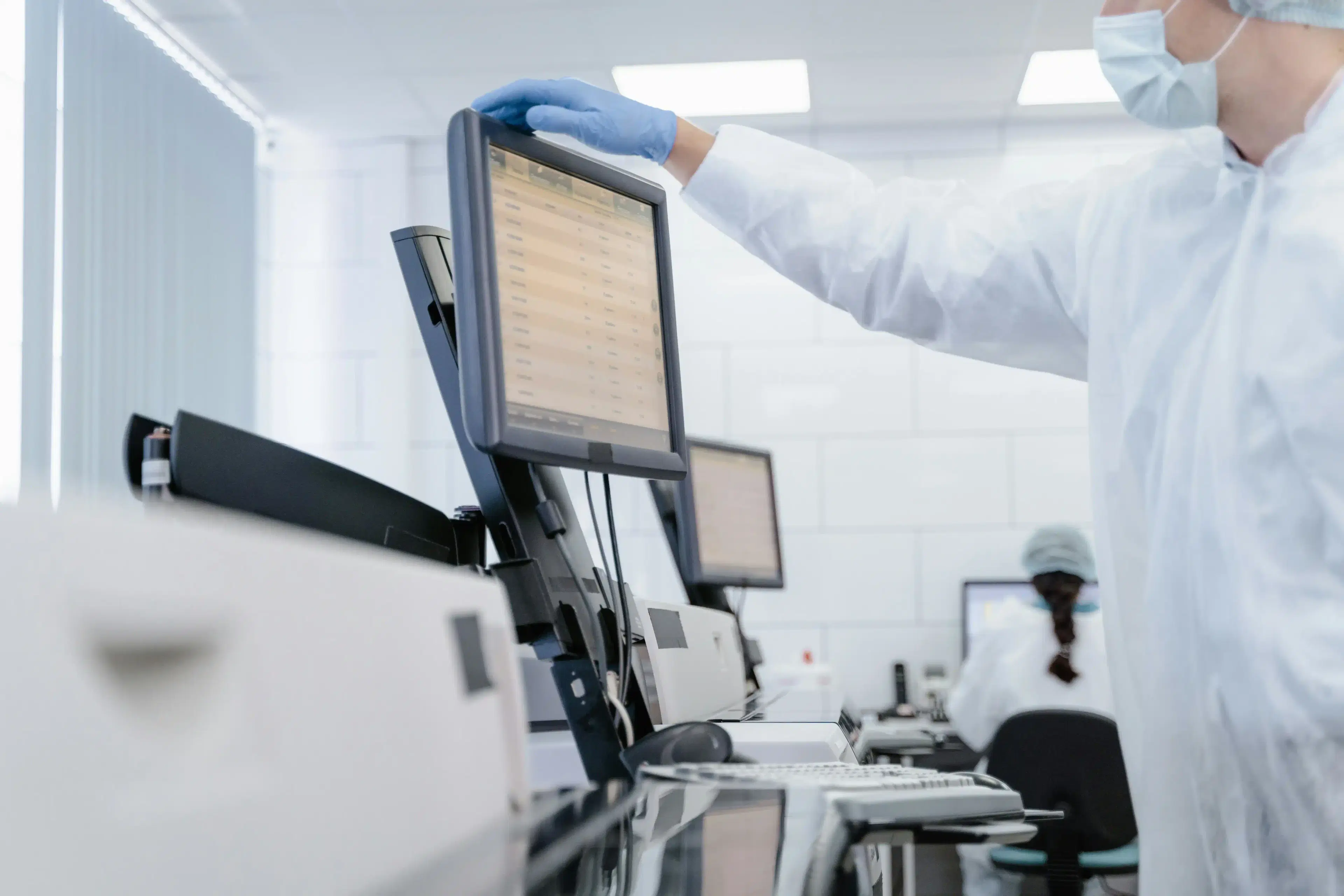


The pharmaceutical CRO and CDMO market reached $277 billion in 2026 and is projected to hit $594 billion by 2035. FDA approvals have increased from 39 drugs per year in 2012 to 50 by 2024, and more candidates are moving through pipelines than at any previous point in the industry's history. Against that backdrop, clinical development timelines have extended by roughly 7 months over the past decade, according to Tufts Center for the Study of Drug Development data.
This analysis, combining portfolio management perspectives from Pharmagro with laboratory software expertise from CodePhusion, examines where that time is being lost and why computational advances have not recovered it.
Part 1: The timeline paradox
Computational models now predict binding affinities and generate novel structures at a speed that was not achievable a decade ago. That acceleration ends at the laboratory door. Once candidates move from in silico characterization into physical testing, they enter infrastructure that was not built for the volumes AI-driven discovery produces. Across all clinical phases, durations have increased:
| Phase | ~2005-07 | ~2010-13 | ~2019-21 | Change |
|---|---|---|---|---|
| Phase 1 | ~27-31 months | ~27 months | ~30-32 months | +1 month |
| Phase 2 | ~33 months | ~36 months | ~39 months | +6 months |
| Phase 3 | ~33 months | ~40-42 months | ~39-40 months | +7 months |
| Total Clinical | ~83 months | ~90 months | +7 months |
Source: MIT Wong, Siah, Lo (2019), Tufts Center for Study of Drug Developments, Pharmagro Analysis
New drugs now spend roughly 43% of their development time in white space between phases, according to IQVIA Pipeline Intelligence data. That gap between phases has widened over the past decade, and computational acceleration has not closed it.
Why are timelines increasing?
The reasons are compounding:
- Greater complexity: modern protocols track more biomarkers and safety parameters than those from a decade ago, with patient-reported outcomes adding further operational load to every trial.
- Shift towards biologics: biologics represented about 29% of FDA approvals in 2010 and reached roughly 33% by 2024. They take longer than small molecules because manufacturing is harder and stability testing is more involved. Characterization studies are more elaborate too. As cell and gene therapies, ADCs, and tri-specifics increase their share of pipelines, this trend will continue.
- Harder disease targets: pipeline shifts toward oncology, rare diseases, and complex chronic conditions extend recruitment timelines. Finding eligible patients for a rare disease trial is a different problem entirely from recruiting for a common condition.
- Globalization of trials: site initiation, patient recruitment, and data collation all take longer when coordinated across multiple countries and regulatory frameworks.
- Shortage of principal investigators: according to Citeline Trialtrove data, active clinical trials increased from 13,255 in 2013 to 22,041 by 2023. The number of qualified principal investigators has not kept pace, delaying trial starts and slowing enrollment.
Part 2: The lab bottleneck
CRO and CDMO laboratories were built for slower-moving pipelines, and as candidate volumes increase, their infrastructure limitations become apparent. CodePhusion's Lab Management Pain Points Survey (Q4 2025, 100+ biotech professionals) quantified the problems.
Why do off-the-shelf systems fail to match lab workflows?
Standard LIMS and ELN platforms are designed around general laboratory use cases rather than the specific operational sequences of any particular lab. Compliance and documentation are handled adequately, but throughput and process speed are not priorities in how these systems are built. The gap between what the platform supports and what the lab actually does gets filled with workarounds. Parallel spreadsheets run alongside the official system, data gets transferred manually between tools, and entire processes live outside the record altogether.
CodePhusion survey results: 55% said their current tools do not match actual workflows. The most common complaint: "systems or tools do not match real workflows" and "too much happening in Excel or Sheets."
How widespread is Excel dependency in labs?
73% of CodePhusion survey respondents rely heavily on Excel or Google Sheets for data management. Spreadsheets work as a substitute for purpose-built tools up to a point, but laboratory data at scale exposes their structural limits. Version control is manual, audit trails are fragile, and a formula error can propagate undetected across months of results before anyone catches it.
Deloitte's 2025 R&D Lab of the Future survey of 104 biopharma executives found that 31% of labs remain digitally siloed with limited integration across systems. Teams manually compile information from disconnected spreadsheets, ELNs, LIMS, and instrument software before any operational decision can be made.
How does fragmented tooling affect throughput?
45% of respondents in the same survey struggle with the time required to keep data organized, and 27% checked every pain point on the list. This is especially visible in smaller preclinical labs where staff carry multiple roles with limited support. Fragmented tooling increases administrative burden and reduces the time available for experimental work, constraining throughput in proportion.
What happens when labs need to adapt workflows?
When a lab needs to adapt a workflow or integrate a new instrument, off-the-shelf tools offer limited options. Changes require vendor involvement and take months. They also cost more than anticipated. A 2012 study in SLAS Technology found that when data flows automatically between ELN, LIMS, and other systems, analysts focus on experimental work rather than system management, with fewer data entry errors and faster processing times. Achieving that level of integration on rigid commercial platforms requires custom development that the vendor is rarely willing to do.
Part 3: Why infrastructure matters more than AI
AI-driven laboratory optimization is often positioned as a direct solution to operational inefficiency, but the premise assumes data quality and integration that labs rarely have. A machine learning model trained on inconsistent, manually-entered data produces unreliable outputs, and an AI scheduling system cannot optimize workflows without real-time visibility into sample status and equipment availability. The operational value of AI in lab software scales with the quality of the data infrastructure beneath it. Integrated, automated data systems need to be in place before AI tools can improve on anything.
Research by Tufts Center for the Study of Drug Development found that integrated CDMO/CRO partnerships addressing operational bottlenecks can reduce development timelines by up to 34 months and generate up to $63 million in net financial benefits. When manufacturing, supply chain, and clinical operations share systems and data, coordination delays between disconnected functions are eliminated rather than managed around.
Part 4: How custom software addresses the operational gap
Custom laboratory software is built around the lab's actual workflow. Instrument data feeds directly into the management system and sample tracking is automated, so teams work from a single operational view instead of piecing information together. Labs that implement integrated sample tracking and automated instrument data capture consistently report faster turnaround times and significant reductions in manual data entry. The gains come from eliminating the coordination overhead between disconnected systems, where staff spend hours re-entering results and cross-referencing spreadsheets instead of running experiments.
Hybrid CRO-CDMO models that combine manufacturing with logistics and clinical trial support are becoming more common. These integrated approaches shorten IND timelines by coordinating batch release, comparability testing, and chain-of-custody for clinical materials within a single operational structure. For labs managing growing portfolios, the capacity to move faster and maintain cleaner data compounds across the multi-year development cycle. Over five to ten years, that difference separates labs that can take on more work from those that cannot.
Frequently Asked Questions
Why are clinical trial timelines increasing despite AI advances?

AI accelerates computational discovery and design, but clinical trials depend on operational execution: patient recruitment, site coordination, sample processing, and data management. Those functions have not kept pace with the computational side.
What percentage of labs still rely on spreadsheets?
CodePhusion's 2025 survey found 73% of biotech professionals rely heavily on Excel or Google Sheets for data management. Deloitte's 2025 R&D Lab survey found 31% of labs remain digitally siloed with limited system integration.
How much time can integrated lab systems save?
Tufts Center research found integrated CDMO/CRO services can reduce development timelines by up to 34 months. Individual labs implementing custom workflow software report 20 to 30 hours of weekly time savings from eliminating manual data entry and system coordination.
Should labs invest in AI before fixing infrastructure?
No. AI requires clean, well-structured data that flows between systems. If lab data is scattered across disconnected spreadsheets and platforms, AI tools have nothing reliable to work with. Data infrastructure comes first.
What is the difference between commercial LIMS and custom software?
Commercial LIMS covers general laboratory workflows and compliance requirements like 21 CFR Part 11. Custom software is built for specific workflows, instrument integrations, and the operational priorities of a particular lab. Commercial platforms work well when workflows are standard, but labs with unique processes or high throughput demands tend to outgrow them.
How do CROs balance portfolio growth with operational capacity?
Integrated systems that give visibility across all active projects make resource allocation easier. Automation reduces the headcount required per trial, so labs can scale capacity without proportional staff growth.
Conclusion
Clinical development timelines have extended by 7 months on average over the past 15 years, even as computational capability and drug approvals have both increased. The constraint is operational: laboratories built for slower pipelines now carry higher candidate volumes, and the tools in place were not designed for that load. Manual coordination and disconnected data systems absorb time and capacity that cannot be recovered by adding AI on top.
CROs and CDMOs that address the infrastructure layer first, through integrated data systems and purpose-built lab software, put themselves in a position where AI can actually work. The ones that skip that step will keep trying to automate processes that are still held together by spreadsheets.
Is your lab infrastructure ready for what comes next? CodePhusion builds custom lab software for CROs and CDMOs that need their systems to match how they actually work.
References
- Pharmaceutical CRO and CDMO Market Analysis - Towards Healthcare
- Tufts Center Study: Time Savings with Integrated CDMO and CRO Solutions - Thermo Fisher Scientific Inc.
- MIT Wong, Siah, Lo (2019), Tufts Center for Study of Drug Developments, Pharmagro Analysis
- CodePhusion Lab Management Pain Points Survey - Q4 2025, 100+ biotech professionals
- Novel Drug Approvals at FDA - U.S. Food and Drug Administration
- Pharma's R&D Lab of the Future - Deloitte (2025)
- Laboratory Informatics Tools Integration Strategies for Drug Discovery - SLAS Technology (2012)
Last updated: April 3, 2026